In this section, I'll cover even more advanced tricks that you'll need to take on some of the most difficult Sudokus. You may need to use some of these tricks together with tricks I went over in The Basics or Intermediate if the puzzle you are doing is very challenging
Black
White
Advanced Techniques
X Wing
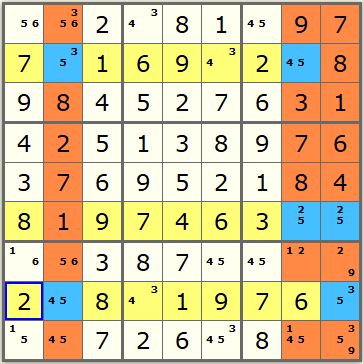
the X wing is an advanced technique that is important as a stepping stone to another technique ill talk about next the Y wing. The X wing is named such for the X shaped relational pattern required to make it work. the X wing requires 4 cells each in a pattern where it has exactly one of the other cells in its row, a second in its row, and none of them in the same box. Each of these cells must be one of two options along one of its planes (row OR column) for a unique digit(s). if this is true you have an X wing and you can remove any pencil marks of the digit from the opposite plane that intersects your digit
Y wing (XY wing)
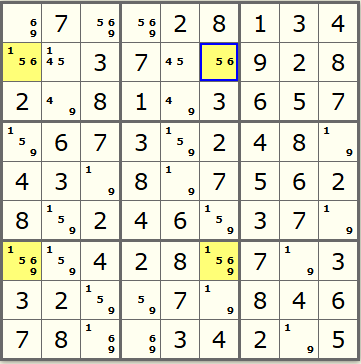
Y Wing, sometimes called XY wing because of its similarity to the X wing technique. The Y wing requires 1 cell the "pivot" to have only 2 avaliable digits. then we must find 2 "pincer" cells, these cells must have only 2 digits avaliable, must share the same number with the pivot, and a seperate number with the other pincer. This relationship will for a unique triple locking the digit that is shared between the two pencirs out of the cell where they intersect(usually this is a single cell).
Swordfish
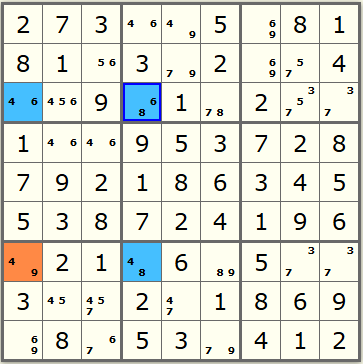
The Swordfish is a very advanced technique and you should not expect to need to use it except in extreamly difficult sudokus. It uses a similar logic as the X wing but instead of looking at two rows/columns we will be look at three. The first step to identifying the swordfish is identifying which digit is your "fish" digit. The fish digit is a digit that shows up 6 times, twice along each connection of where the three row and column met. this pattern as i'll show in the figure below will allow you to remove the "fish" digit anywhere else along those rows and columns.